
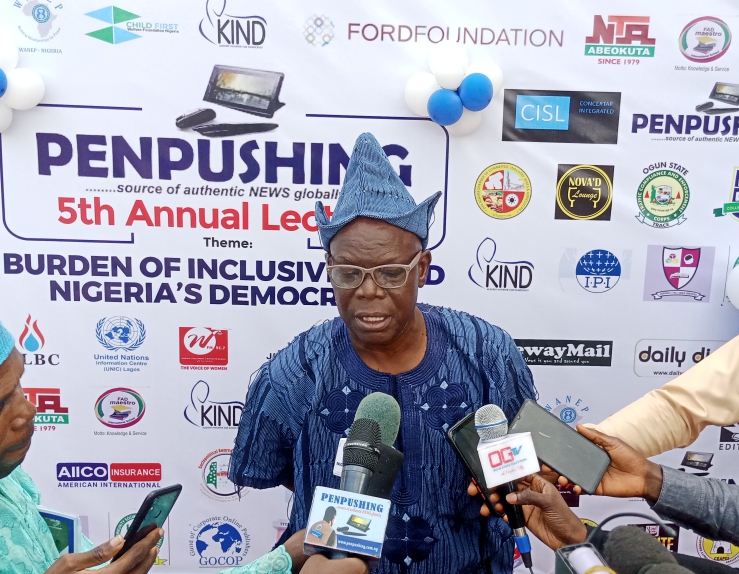

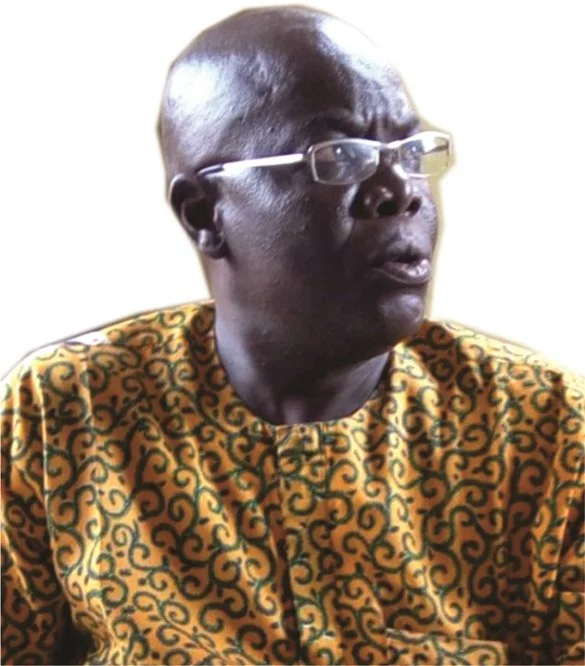
This interview is part of the AiAfriq Interview Archive, a growing collection of intergenerational conversations exploring childhood, technology, memory, culture, and social change across generations. In this two-part conversation, veteran journalist and community elder, Prince Dimeji Kayode-Adedeji, reflects on what it looks like growing up as a kid before the arrival of the internet, smartphones, and artificial intelligence. The conversation took us through his childhood play, friendship, respect, communal living, journalism, misinformation, AI, and the preservation of Yoruba culture.
but because I saw Soyinka and I know his… level and caliber, I concluded within me that if Professor Wole Soyinka can attest to this medication or this drug, then it means it’s a good product. I ordered that drug.
Bio
Interviewee: Prince Dimeji Kayode-Adedeji
Occupation: Veteran Journalist, founder Penpushing Media
Location: Abeokuta, Ogun State, Nigeria
Date: December 2025
Born: July 28, 1963.
Themes: Childhood, Community, AI, Journalism, Yoruba Culture, Fake News, Family Structure
Journalism in the Age of AI
We are into it; that’s the truth. We should not rely solely on AI for information and think we will make headway.
AI and the Rise of Emergency Journalists
I’m a very blunt person; the issue of AI is a very big and tough challenge for journalism practice, a serious one, a very serious one. It has its own advantage but it has lots of disadvantages. Because when it happens, if you’re not careful, it will destroy many things. it can destory the entire world, if care is not taken, apart from professions. Because you see lots of images that are not correct. The bloggers make it worse. And I do tell people, and I remember Baba Oshoba, who is our veteran on this job also say this, that bloggers are not journalists. You see people when they have Android phones and there’s an accident, you see some people they just pick their phones, and say “it’s happening now, it’s happening now,” recording. What is happening now? At the end of the day, maybe nobody dies there, these people will be telling you that all the occupants of that vehicle, they’re dead.
I have seen cases where you ask a question from AI, if you’re intelligent enough, some answers, you need to sit down and look deeply about that response. What I’m saying is that one has to be very, very careful, with every information. Kayode Soyinka, a veteran journalist, was here on a visit sometime last week. He met some of my staff and the interns here. And before he came, I said he’s coming on a visit, so that when you want to ask questions, you should know who this man is. I said, go and Google. They Googled, they read out the profile of Kayode Soyinka to me. One of the information given was that he was a publisher of “Observer newspaper,” where the man never worked. And this man is the publisher of “African Today” based in UK. But the profile on the Google said…, if I didn’t know that, I will run with that wrong information or misinformation. That’s why I said one has to be careful. I’m not saying some of the information is not correct. You understand. But you still need to do your findings very well so that you don’t misinform the public. That’s the danger there. And my fear is that a lazy journalist who occupies himself with AI would continue to misinform the general public. I repeat, a lazy journalist who relies 100% on AI will continue to misinform the world. We need to be very, very careful. It can destroy, it can maim, it can even destroy a home if care is not taken. You understand. So that is my concern about AI.
Policies
Let me say this in the first place. If we want it to work, government, as far as I’m concerned, this is a personal opinion; government should make it a policy that they make public that all information that is not emanating from genuine journalists, I say genuine because we have some bad eggs, should be ignored. And make it a policy, tell the public, in their own interest, if you don’t get any news from a media source, ignore that news. It is the responsibility of a journalist; if that news is a little bit confusing, a journalist can have access to it and do further findings on it. Do you understand? If the government can put in that policy that if you are not a rekon or recognized journalist, you don’t pass out information because you will see that most of these people you cannot even trace them. You won’t be able to trace them. Our people should have the culture of ignoring messages, news from non-journalists, if they ignore it, it will help.
People who are engaged in fake news, they can destroy the whole world, and somebody who wants to destroy the whole world, must that person be in the society?
Victim of AI
Let me give you an example that also affects me. This AI issue we’re still talking about. On Facebook, you see lots of advertisements that have to do with medications. There was one; they used an image of Professor Wole Soyinka to advertise a blood pressure drug. And Wole Soyinka was confirming in that video, confirming the authenticity of that drug that they’re trying to put to the public. Now, I waited for a number of days, thinking Professor Wole Soyinka would come out and deny that he’s not in the know of that thing. Because they did it in a way that the voice, the look, and everything were Soyinka’s. When I saw it, I have, I’m nursing a BP, but because I saw Soyinka and I know his… level and caliber, and I concluded within me that if Professor Wole Soyinka can attest to this medication or this drug, then it means it’s a good product. I ordered that drug. The drug I was using for my BP, because of what I saw, and I saw Wole Soyinka, I just dumped those drugs and started using that one because in the advert it said it would cure BP rise permanently. I ignored the drugs I was using and started using it. But in the course of using it, one must be very observant. I noticed that I didn’t see any changes. You understand? It was then I started suspecting foul play. I had to make contact to find out from a source to Professor Wole Soyinka, only to discover that it was AI. I was a victim of that AI as well. And the question I asked that, I was expecting Professor Wole Soyinka to come out, and I was told that he may not even be aware that things like that are going on. And besides that, how many audio clips or video clips would he be reacting to? I was a victim of it. If I wasn’t careful enough, the drugs that would do me good, I abandoned the drugs and started using the drugs promoted by AI. That’s the danger there. If I was a victim of that at my level, do you know the number of people that would have also been victims? and the government kept quiet, it’s not good enough. They should start getting those people arrested. It’s a way of deceiving people because they want to make money at the expense of ignorant people and innocent people. So there must be a policy that, look, if you don’t get news from a credible media organization, don’t bother. Even if the one they’re sending is seen as “credible.” Don’t rely on it. Let the journalists who are more passionate about the profession report first.
Regulation
There must be a regulation. There must be a regulation in the sense that for every information that you receive from AI, we must still vet it. You will still need to vet. If you don’t vet, and you just package everything together. It means you’re not regulating. Government itself must also be proactive in the area of what I have just said. I’m not saying government should turn itself into a warlord in terms of using the error of AI to deal with journalists. But when there is a need to do immediate correction, there is no shame in it. You refine some decisions in the interest of the public and for the national interest; anybody can make error. But you don’t say you have to want to keep shy or want to keep away from correcting yourself because people will see you as somebody who’s not forthright. Anybody can; there can be mistakes anytime. But the moment you discover that you don’t waste time in doing that correction before it is too late. There must be that measure put in place because I said it; it has its own advantages, but it has larger disadvantages. We need to be extra careful.
They should be Jailed!
It’s a worrisome situation, I must say this, and a very serious journalist, I repeat, a very serious journalist. You don’t rely 100% on AI. If you want to make headway, you don’t. Look, fake news is something, if it happens to you, you know what it means. If you’re a victim of fake news, and ironically this period we are now, unlike before now, if anything is written about you that is bad. The child unborn as at today, if they born a child in another 20 years and he Google it, it will still make reference to you. You can see the danger there. If I have my way, why must you, for God’s sake, why must you engage in fake news? What do you want to gain? What do you want to gain by propagating fake news? It will never be my portion. I repeat it, it will never. I will never, never support or subscribe to the dissemination of fake news. No. People who are engaged in fake news, they can destroy the whole world, and somebody who wants to destroy the whole world, must that person be in the society? If I had my way, they should jail them. They should not toy about this issue at all. Fake news can destroy the entire country. Just a second fake news. A fake news that they publish for one second can destroy the entire country. I don’t know why people venture into it. I don’t know why people, some people are so much passionate about propagating fake news.
When we started Penpush, because of the way Penpush was going, there was an attempt to snatch our website because they know, they were aware that Penpush is doing well. So they wanted to seize that opportunity. I know the step we took before we crushed them. We will never, everybody knows that. They know that when we write, as a person, it may not be comfortable to some people. But the truth is that you can’t fault it. I repeat it. Nobody has ever, since I started journalism career, over 30 years, nobody has ever come to fault my report. Nobody. If I don’t do that as a young reporter, it is now I will be doing that. No, no, no, no. Nobody, I repeat it. It’s about passion. One must be contented with what you are doing. The generation of journalists now, they want to fly before they crawl. And I always warn them, there must be sacrifice. Sacrifice will pave way for you. Sacrifice will add value to you. But if you’re after money first, money, money, money, money, you will lose relevance.
AI – It can destroy, it can maim, it can even destroy a home if care is not taken. You understand.
Closing Reflection
More than nostalgia, this conversation reveals anxieties about truth, memory, identity, and the speed of modern digital life. It reflects a growing concern that while technology continues to advance rapidly, human judgment, cultural continuity, and communal living may be weakening quietly in the background.