


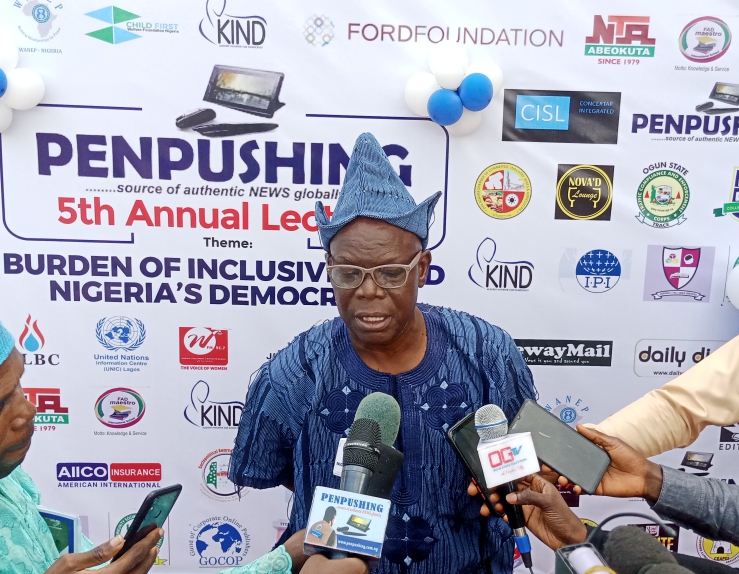
This interview is part of the AiAfriq Interview Archive, a growing collection of intergenerational conversations exploring childhood, technology, memory, culture, and social change across generations. In this two-part conversation, veteran journalist and community elder, Prince Dimeji Kayode-Adedeji, reflects on what it looks like growing up as a kid before the arrival of the internet, smartphones, and artificial intelligence. The conversation took us through his childhood play, friendship, Respect, communal living, journalism, misinformation, AI, and the preservation of Yoruba culture.
Bio
Interviewee: Prince Dimeji Kayode-Adedeji
Occupation: Veteran Journalist, founder Penpushing Media
Location: Abeokuta, Ogun State, Nigeria
Date: December 2025
Born: July 28, 1963.
Themes: Childhood, Community, AI, Journalism, Yoruba Culture, Fake News, Family Structure
“There is nothing wrong in adopting technology, but we must also inject our own culture into it.”
Pre-Digital Life:
Childhood, Culture and Community
Brief Introduction
I attended St. Clara’s Nursery School, Oshogbo, one of the best schools in the Southwest of Nigeria. We enjoyed our childhood period. There was peace. Though there’s youthful exuberance, which is applicable for every generation. It depends on the way and manner it is being handled.
Peer Relationships
In those days, we the kids moved together; we played together. We go to the football field together to play football. Even when coming from school, we would trek together; we would be making sort of fun together. If we get to the house of one of us, maybe that’s the first house we get to, we can branch in that house to drink water. There’s always taps on the road. Water was still very available then. While going, you will see us branching at the tap trying to take water one by one as we follow each other. It was fun throughout.

Night-life and Celebrations
Then, during that period, particularly in the night, if the weather is too hot, you see us place a mat (eni) on the open floor. That’s where we all sleep together. If Muslims are having Eid al-Fitr, we do that together. We join our Muslim colleagues. We eat together. We were not involved in the fasting (awe), but we eat together with love. During Ileya, the family here would bring food from their house to your house. You will repeat the same thing: food from your own house, you take it to their house. Similar thing with Christians and the Christmas period. It was something that was very, very interesting.
if you see me anywhere, it doesn’t take me time to prostrate for elderly people. I’m in my 60s… I don’t say because I’ve attained a certain age or level. But your generation…
Communal Discipline
If a child misbehaves, you don’t need to wait for the parents, the biological parents, before he’s disciplined. The parents of other people will discipline that child and even inform the father, the mother that “he misbehave o, we have disciplined him, this is what we did.” The parents would be satisfied with that. It was something that was very interesting. But unlike today, the younger ones can even trade away their colleagues because of money.
The Phone Effect of Today
Then the issue of telephones that comes in has made it difficult for them to relate to each other one-on-one; rather, they will be doing that on the phone. Whereas, in those days, I can move from my house to your house and say I’m coming there to play. Not only that, I can even take the consent of my parents that I’m sleeping in your house. And the parents of my colleague, my friend, they would welcome me, and vice versa. So it was the period that was very interesting. Very, very interesting.
you go to the library… There’s no internet. You go extra mile, you read. You want to read overnight so that you don’t sleep; you take Nescafé. You can’t go into Google. That one brings laziness.
Play and Fun-time
The one we did, we call it “ile eye”. You use your leg to build a house for birds. Don’t forget again, there were also a number of pranks to play. Then, our stubbornness then was a positive stubbornness. Not some stubbornness that will be taking you to the police station today. It’s stubbornness that were positive stubbornness. We struggled hard to get things done.
Extended Family Bonding
When we were growing, I have a family, like a family, a larger family. I have siblings, I have uncles. Now, there’s something that is unique, based on what you have just said. Our fathers then, you know, they were in various towns. We have someone living in Lagos, Zaria, Ibadan, everywhere. Now, because of their affection and the family, the way the family designed it, we the children, when we are on holiday this term, we go together to visit one of our uncles. Another term of holiday, we move together to another uncle. That’s how we spread round on holiday to visit our uncles. We go together in a bus prepared by the family. And that thing is still manifesting till tomorrow between me and my siblings, we still have that memory, lovable memory.
we must make culture and tradition compulsory in our educational system.
The Yoruba Culture of Respect
My father when he was 70. One of his junior brothers was 65. I remember very well. And that sticks to my brain till tomorrow (that is family background). We were in the family house in Ilesha (I’m an Ijesha man; my mother is from Abeokuta here). We were in the house. You know every year we go home. That my uncle, who was my father’s junior brother, a 65-year-old man, when he entered the family house, they didn’t tell me; I saw it. He prostrated to greet my father at 65. He prostrated to greet my father, who was 70. And he was 65. But your generation, it’s either you say “hi” to an elderly person. So that thing is in my memory till tomorrow. That’s why you see me; if you see me anywhere, it doesn’t take me time to prostrate for elderly people. I’m in my 60s. When I meet some personalities that I know that “won ju mi lo now,” I still prostrate for them. I don’t say because I’ve attained a certain age or level. No. That’s one of the lessons I learned when I was growing up. So that thing is also extended to me and my siblings. There’s one in Ibadan, Seyi. When he greets me, he would prostrate. Seyi is over 50 now. At a point I told him, “You’re embarrassing me. Why must you prostrate for me in public?” Because that’s the way we were brought up.
Preserving Our culture
We have a job and a role to play so that our culture doesn’t go into oblivion. And that is another challenge. And to address that, your generation should be advised or encouraged to retrace their steps. Look, my daughter that is in the UK, I mandated her and her husband. Let your child speak English in school. When she gets home, speak Yoruba to her. And they adhered strictly to what I said. So most of the time when they are at home, they speak Yoruba. When they call on video, when I want to talk to the girl, I speak Yoruba. So it is left for, particularly, those of them in other countries; you don’t throw away your culture while there. That’s why I give it to the Hausas and the Igbos, there’s nowhere they go in the world their children will speak their language. So we should also cultivate that habit, particularly Yoruba. We must try as much as possible. Not only us, even with your generation, you must equally encourage your peers on the need to make sure that the culture and the heritage will not go into oblivion.
Technology and Culture
There’s nothing wrong in adopting technology, but we must also inject our own culture into that technology. It’s as simple as that. We must inject our own into it. Now, if we look at it from this angle again, the issue of culture, like you rightly said, is about community involvement. Despite the fact that the technology is there, I still say that we can also inject our culture into it. Now, let’s start from the school. If the government makes it mandatory that culture and tradition should be part of the subject, it is also good because it will continue to be in the brain and conscience; if you do away with it, that’s where the danger is. So if I have the opportunity, we must make it compulsory in our educational system because it is through that that you learn many things that have to do with culture. I recall that when we were growing up, we had the books we called “Alawiye.” And these are what gave us the opportunity to know many of these Yoruba things to motivate the younger one to show interest in the Yoruba culture. That’s why I said it should also be injected in the technology. Even with the technology you are talking about, if I want to watch anything that has to do with culture, we can easily get it. So why don’t we face it rather than looking for the Oyinbo type? You are aware that even the Oyinbos are coming to learn the Yoruba language. Your generation should encourage yourself on the need to retrace your steps. Everything should not be about Oyinbo. Before you know it, you may lose relevance. And if you are not careful, this Oyinbo will still come back to be teaching us Yoruba if we are not very careful. I know Oyinbos who are beating the drum (talking drum) perfectly, more than even the owners. There’s nothing wrong there because we also get part of their culture. But it will be very sad for them to be teaching us our culture. So we need to retrace our steps.
Reading
For that one, nobody needs to tell you you have to read o. You know what will be the end result if you fail to face your studies. You face your school squarely; you face your studies squarely. You ignore certain things. When you’re to do any social activities, you do them with love. Not that you’re trying to cut corners. Imagine these days, parents will be looking for special schools for their child to pass examinations. Nothing like that in those days. If you don’t pass, you will do it again. You have to improve to pass before you gain admission into higher institution.
it has its own advantage. But we have to be cautious of the disadvantages because of the volume.
The Process of Studying
Library: you go to the library; that’s what we do. And interestingly at that time, there was a period we had free education, so books were available. It’s about the books. You buy books. It’s that book you’ll read. There’s no internet. You can’t go into Google and say what you want to… no. It’s purely books. There’s no other thing. You go extra mile, you read. That’s what we call burning candles (night candles). You read. Do you know while we’re in school then, at a point when you want to read when exam is coming, you get a bucket of water, you put your leg inside. So that you have cool body. Not only that, ignorantly, so to say, at times, we take what we call Nescafé. Nescafé would not let you sleep so that you could read. It was done ignorantly. I’m only telling you what happened those days. You want to read overnight so that you don’t sleep; you take Nescafé. It has its own demerit, which was not known to us, but it works for us. Then you can put water in a bucket and put your leg inside. When your leg is in the water, you won’t sleep now. Do you understand? Because of the cold. Those were the things we did those days. Not you just wake up, pick your phone, you google. That one brings laziness. But that’s the way we find ourselves now. That’s the difference.
The Danger of Digital Dependence
Lots of havoc may happen. Do you know some doctors now, I call them “Google doctors”. When you approach some doctors now, as a patient, when you complain to them, they go to Google to type. It is Google that gives them results and gives them medication. Whereas, before now, I recall that there was a book called MIMS (Monthly Index of Medical Specialities). That MIMS is a medical book. Very small like this. Doctors can always read from that to get knowledge. But now these days, I don’t know. All what they do is they Google, if you say you have a headache, they can Google it and say “he has headache, what can be done?”
The Way Out for the Preservation of Humanity
We will take it the way it is o. When we talked about humanity, there are two ways to it: there is a popular saying, “If you cannot beat them, you join them.” But the danger associated with joining them is another thing. Because now, for example, before now, when we talk about journalism, it’s about newspaper. What happen today, you will read it in the newspaper tomorrow. But with the advent of technology, as it happens now, in another 10 minutes, it’s all over the world. So it has its own advantage. Everything has advantages and disadvantages. But we have to be cautious of the disadvantages because of the volume; that’s the only thing here. Now I want to travel to Lagos. I can ask Google what the road looks like. And it will tell me. So it’s now left for me to stay or to continue the journey. And it can even come out with wrong information at times. Like the example I gave you, a Google that took a passenger and driver to a river. This issue of technology, you cannot escape it, you can’t do away with it. But we need to be very cautious.
Tags: AI, Oral History, Journalism, Yoruba Culture, Childhood, Community, Digital Society